
Digital marketing strategies have historically been shaped by how search engines present information. When search results consisted primarily of ranked links, content was optimized to attract clicks. As AI-driven answer engines increasingly deliver responses directly, that approach is no longer sufficient.
In answer-first search environments, visibility depends less on how compelling a headline appears and more on whether content can be interpreted, extracted, and reused by machine systems. This shift is forcing marketers to rethink how content is structured at its core.
Why Structure Matters More Than Ever
AI-powered answer engines are designed to resolve user intent efficiently. They do not browse pages the way humans do. Instead, they scan for clearly articulated explanations, definitions, and contextual signals that can be assembled into a coherent response.
Content that buries its primary insight deep within marketing language or narrative introductions is less likely to be surfaced. By contrast, content that presents its answers directly, supported by concise context, is easier for AI systems to interpret.
A recent study by McKinsey & Company indicates that nearly half of consumers now intentionally use AI-powered search engines, often preferring them to traditional search for insights. As this reliance grows, the structure of source content becomes a determining factor in whether it is included.
From Pages to Answer Units
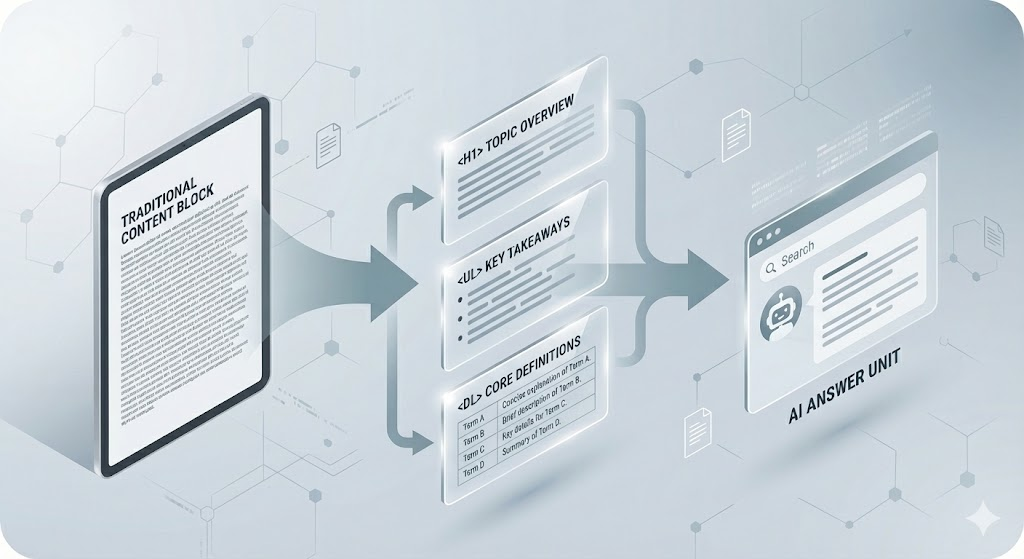
One of the most significant changes introduced by answer engines is the shift from page-level evaluation to answer-level extraction. AI systems are not attempting to rank entire documents. They identify discrete units of information that stand on their own.
This means content must be modular. Each section should answer a specific question or resolve a clear sub-intent. Headings should reflect natural language queries rather than keyword variations. Paragraphs should be self-contained and unambiguous. Incorporate tools such as schema markup, FAQ schemas, and structured data to facilitate the creation of answer-ready content.
An industry analysis of page-centric SEO limitations shows that answer engines favor content structured as a series of resolved questions rather than a single persuasive narrative. That shift is examined in a detailed breakdown of why SEO frameworks alone struggle in AI-driven search.
Language Clarity Outperforms Brand Voice
Traditional content strategy often prioritizes brand tone and differentiation. While those elements still matter for human readers, they can interfere with machine interpretation if they obscure meaning.
Answer engines favor neutral, descriptive language. Definitions should be literal. Claims should be supported by context rather than emphasis. Metaphors, slogans, and subjective phrasing reduce extractability.
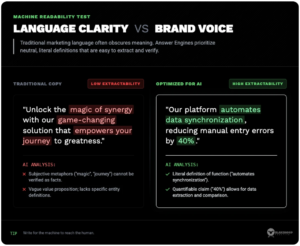
Data from Google’s helpful content guidance reinforces this principle by emphasizing clarity, usefulness, and intent resolution over stylistic optimization.
Formatting for Machine Readability
Beyond language, formatting plays a critical role in how AI systems process content. Clear headings, logical hierarchy, and consistent terminology improve machine comprehension.
Effective answer-oriented formatting often includes:
- Direct answers placed immediately after section headers
- Short paragraphs that focus on a single idea
- Lists used to enumerate steps, criteria, or components
- Consistent use of terms across related sections
This approach does not eliminate storytelling, but it reframes it. Narrative becomes a supporting context rather than the primary delivery mechanism.
Entity Consistency Signals Expertise
Answer engines evaluate expertise through consistency as much as through credentials. When an entity explains a concept consistently across multiple contexts, AI systems are more likely to recognize it as authoritative.
This places new emphasis on internal alignment. Content teams must ensure that definitions, frameworks, and terminology remain stable across articles, guides, and explanations. Inconsistent phrasing weakens machine confidence.
Research into language model behavior shows that repeated, consistent explanations across sources increase the likelihood that information is reused in generated answers. Authority, in this sense, is cumulative.
Designing Content for Reuse, Not Just Reading
The ultimate goal of Answer Engine Optimization is reuse. Content must be capable of standing alone when removed from its original context.
This requires a mindset shift. Marketers must assume their content will be quoted, paraphrased, or summarized by AI systems. Each section should make sense independently, enabling the production of versatile content that adapts to evolving search environments.
As answer engines continue to evolve, organizations that adapt their content structure accordingly will find their ideas echoed more frequently, even as traditional engagement metrics fluctuate.
The New Content Standard Is Interpretability
The rise of AI answer engines is redefining what constitutes effective content. Pages are no longer optimized solely to attract clicks. They are optimized to be understood.
Structure, clarity, and consistency are becoming competitive advantages. In an answer-first landscape, content that communicates plainly and resolves intent directly is more likely to shape the information users receive. That influence, while less visible, is increasingly decisive.