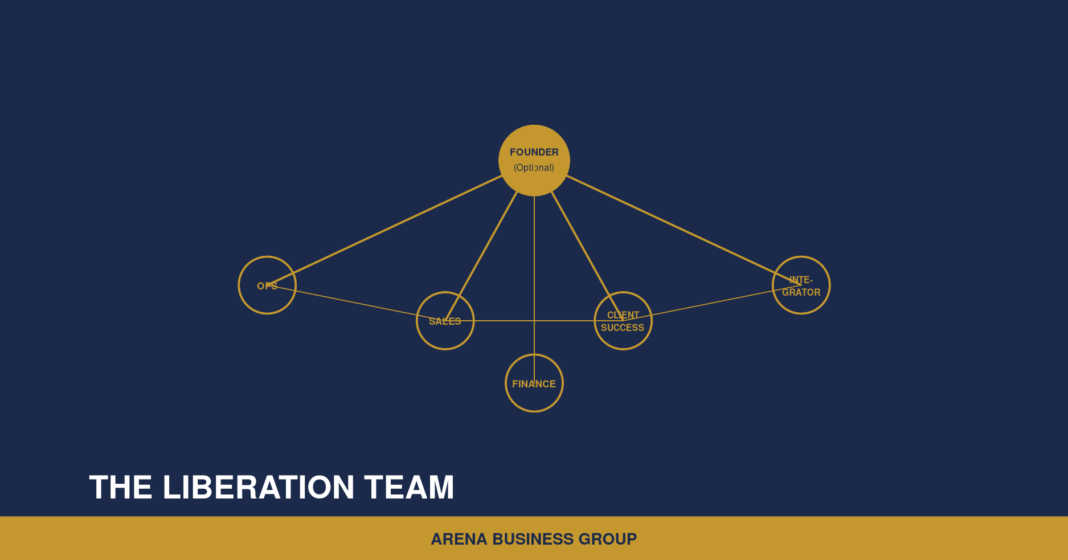

The Liberation Team: Five People Who Set Founders Free
Inside the framework that turns overwhelmed business owners into optional executives.
Arena Business Group | https://www.arenabusinessadvisors.com/ | February 2026
Ask a founder what keeps them up at night and you will get a dozen different answers. Cash flow. A difficult client. A key employee who might leave. But underneath all of it is one universal fear: what happens if I step away? The answer, for most small business owners, is: everything falls apart. Arena Business Group thinks that answer is a design flaw, not a destiny.
Their solution is a concept they call the Liberation Team: five specific roles that, when filled by competent people, allow a business to operate independently of its founder. It is not a revolutionary idea. Large companies have had executive teams for centuries. But Arena has adapted the concept for the small business world, where a five-million-dollar company often has one decision-maker surrounded by a team of task-executors.
The Operations Lead
This is the person who makes the trains run on time. They own the daily workflow, manage capacity, and ensure that client commitments are met. In most founder-dependent businesses, this role is filled by the founder on instinct. Moving it to a dedicated person is often the single highest-impact change a business can make. When the operations lead handles the 5 a.m. crisis calls, the founder’s phone goes quiet.
The Sales Lead
Revenue generation is where founder dependency hits hardest. In many small businesses, the owner is the rainmaker, the person who brings in every significant deal through relationships and reputation. The Sales Lead does not replace the founder’s relationships. They build a repeatable process around them: a pipeline, a follow-up cadence, a qualification framework. The founder’s Rolodex becomes the company’s system.
The Finance Lead
Beyond bookkeeping, the Finance Lead owns cash flow forecasting, margin analysis, and financial reporting. They give the business a dashboard that does not live in the founder’s head. For buyers evaluating an acquisition, clean financials managed by a competent person signal maturity and reduce perceived risk.
The Liberation Team does not replace the founder. It reveals what the founder was always supposed to be: the architect, not the building.
The Client Success Lead
In service businesses especially, client relationships are the single most valuable intangible asset. The Client Success Lead ensures those relationships belong to the company, not to any individual. They own the onboarding experience, the check-in cadence, the renewal process. When a client’s primary relationship is with a role rather than a person, the business becomes dramatically more resilient.
The Integrator
This is the role that ties everything together. Borrowed conceptually from the EOS framework but adapted for Arena’s model, the Integrator ensures cross-functional alignment. They run the weekly leadership meetings. They resolve conflicts between departments. They translate the founder’s vision into operational priorities. In many ways, they are the founder’s replacement in everything except title.
Arena does not suggest that every business needs to fill all five roles immediately. For a company doing two million in revenue, some of these roles might be part-time or combined. The framework is about intention, not headcount. It is about deliberately designing an organization where critical functions have clear owners who are not the founder.
The magic of the Liberation Team is what happens after it is in place. Founders describe a shift that is equal parts relief and disorientation. Relief because the weight lifts. Disorientation because they have to figure out what to do with their time. Most discover that the work they actually enjoy, the strategic thinking, the client relationships, the creative problem-solving, was always buried under the operational noise.
The Liberation Team does not replace the founder. It reveals what the founder was always supposed to be: the architect, not the building. And architects, as it turns out, are much happier when they are not also pouring the concrete.
- • •