
Author: Oleksandr Khodorkovskyi — founder and expert in AI, game development, gamification, and digital transformation. Oleksandr has spearheaded several innovative projects, including the educational platform ShodennikUA and the game development company SuperBitGames, which focused on creating educational games. Throughout his career, he has implemented gamification in education, corporate processes, and marketing. His experience extends beyond game creation, as he applies gamification principles to solve complex problems in business and everyday life.
After several years in game development, I realized a simple truth: people don’t just need games — they need a sense of achievement and recognition of their successes. This principle became the foundation of my approach to implementing gamification across various business and educational fields. Today, gamification is no longer just a buzzword — it has become a powerful tool for transforming human behavior and engagement.
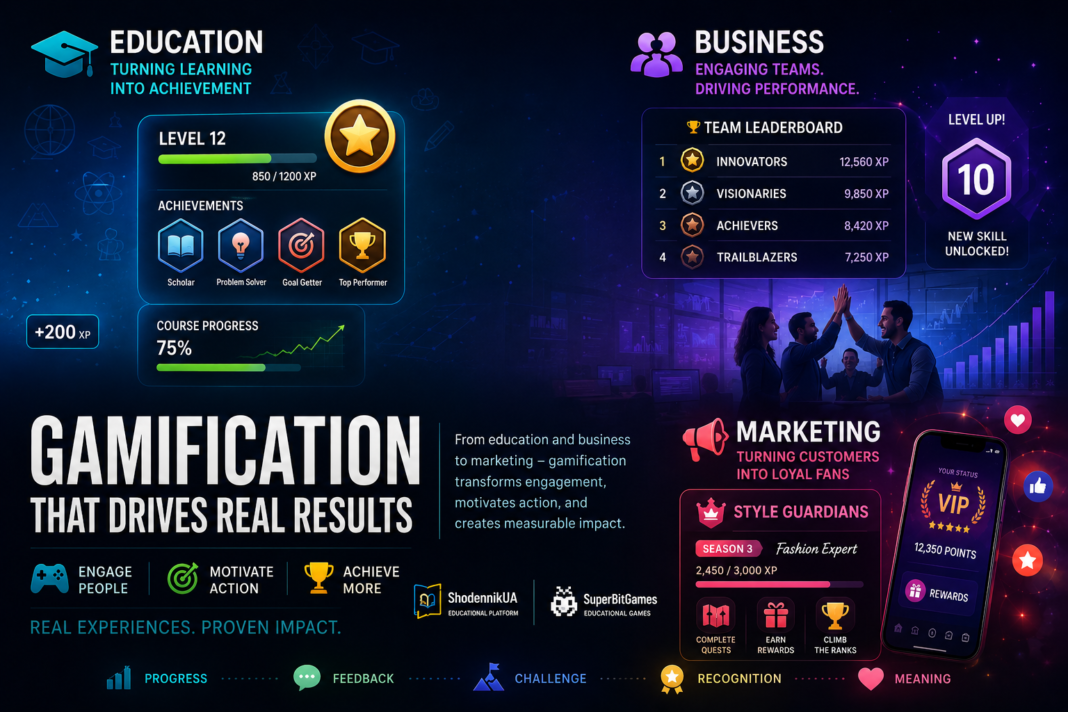
My experience shows that gamification is much more than simply adding game elements to non-game processes. It is a broader approach to designing experiences that make progress, feedback, and motivation more visible and meaningful. Across educational platforms, corporate training systems, and marketing initiatives, thoughtfully designed gamification can improve engagement and enhance user experience. Below, I will share my experience implementing gamification in three key areas: education, where it transforms the learning process; business, where it enhances employee engagement; and marketing, where it creates a new level of customer interaction.
Why Gamification Works
My experience in the gaming industry taught me one key lesson: achievements, feedback, and visible progress can be powerful motivational tools for many users. Working on various projects, I found that, depending on the audience and context, users may respond particularly well to measurable progress, recognition, meaningful challenges, social interaction, and a sense of control over the process. These elements contribute to what makes many games engaging, and when thoughtfully adapted to non-game contexts, they can support stronger participation and motivation.
One of the most illustrative examples for me has been my work on educational platforms. When we started implementing levels and achievements, I saw how user behavior changed. Simple visualizations of progress, like completion indicators or sets of “stars,” turned routine tasks into engaging quests.
One of the most important lessons I’ve learned is that gamification can support motivation by making progress more visible and feedback more immediate. When people can see their development, receive timely feedback, and work toward meaningful rewards, the experience draws on principles such as clear progression, achievable challenges, and a sense of accomplishment that make many games engaging.
Revolution in Education
Working on the ShodennikUA educational platform and as the founder of SuperBitGames, I saw firsthand how gamification could radically change approaches to learning. ShodennikUA wasn’t just an educational platform; it was designed to foster engagement through gamified learning pathways. For example, we introduced achievement systems, competitive elements, and rewards for completing assignments. These features helped turn mundane learning processes into exciting, goal-driven experiences.
“Gamification isn’t just a feature — it’s a strategy,” I often say. Our platform showed that when learning is treated like a game, students become active participants rather than passive listeners. As a result, academic performance increased by 10%, and more importantly, students’ attitudes toward learning transformed.
At SuperBitGames, one of our focuses was on creating educational games that helped children develop cognitive and problem-solving skills. By blending storytelling with interactive tasks, we made educational content engaging and enjoyable. These experiences not only laid the foundation for my understanding of gamification’s power but also demonstrated how versatile game mechanics can be across different contexts.
Transforming Corporate Culture
In my consulting practice, I often encounter employee burnout caused by repetitive, monotonous tasks. When thoughtfully integrated into workplace processes, gamification can make routine activities more engaging and give employees a clearer sense of progress. Companies such as SAP have applied gamified approaches to corporate learning, using challenges, progress tracking, and recognition to make training more interactive and motivating.
Gamification has proven especially effective in three key areas of corporate culture. First, onboarding new employees: turning the orientation process into an engaging journey with checkpoints and rewards can increase new hires’ engagement by 25%. Second, team collaboration: introducing collective achievements and interdepartmental competitions strengthens the corporate spirit and boosts productivity. Third, professional development systems: creating “growth maps” with clear levels and rewards for acquiring new skills motivates employees to pursue continuous improvement.
One standout project involved a major tech company where we implemented a system of “professional quests.” Employees could choose tasks of varying difficulty, earn experience points for completing them, and unlock new levels of professional mastery. Within the first three months, the number of proactive projects increased by 60%, and job satisfaction levels rose by 25%.
Revolution in Marketing
The results I’ve seen in marketing and customer engagement are especially impressive. Loyalty programs with gamified elements demonstrate remarkable efficiency. Starbucks, for example, increased daily user activity by 15% after updating its loyalty program in 2021, further proving the power of gamification.
The real breakthrough occurs when we go beyond simple point accumulation. In my practice, I developed a three-level model of marketing gamification. At the first level, we create a basic rewards system: points, statuses, and achievements. At the second level, we add social elements such as leaderboards, team challenges, and the ability to share achievements. At the third level, we incorporate a narrative component by connecting activities through a common storyline, creating game “seasons,” and hosting thematic events.
When working with a major retailer, we applied this model to their loyalty program. Customers didn’t just accumulate points — they became “style guardians,” completed themed quests, and competed for the title of the season’s best fashion expert. The results exceeded expectations: average purchase value increased by 15%, and repeat purchase frequency rose by 10%.
The key insight I gained is that successful gamification in marketing should create not just a reward system but an entire ecosystem of interaction with the brand. When customers feel like participants in an engaging experience rather than simply consumers, the nature of their relationship with the brand begins to change.
Looking to the Future
Working at the intersection of technology and human behavior, I see how gamification is evolving with the rise of artificial intelligence and data analytics. Today, we can create more personalized and adaptive systems that consider each user’s unique characteristics.
What inspires me most is the development of gamification in healthcare. Apps designed to promote healthy habits using game mechanics show how we can influence daily behaviors to improve people’s lives.
Conclusion
Over the years of working with gamification, I’ve come to appreciate its immense potential. It’s not just a set of mechanics — it’s a way to rethink how we interact with people in any field. From education and healthcare to corporate training and marketing, properly implemented game mechanics can make many processes more engaging, structured, and effective.
Gamification creates environments where people want to participate rather than feel obligated to do so. It not only helps achieve goals but also makes the journey enjoyable. This approach sets new standards for engagement, which are crucial in today’s world, where attention is a highly competitive resource.
In the future, I see gamification not just as a tool but as part of our everyday lives — from smart educational platforms to systems that encourage self-care and environmental responsibility. This field is only beginning to unlock its potential, and what it will become in 10 years depends on us.