


By Carter Jensen 5/4/26
International practitioners at the Cases & Faces Conference reveal the management failures that cause 80% of AI projects to collapse.
Professionals from all over the world gathered at the Broward Center of Innovation in Davie, Florida, on April 11, 2026, for an event that can be described as an industry reckoning. The Cases & Faces Conference & Award promised something the AI hype cycle rarely delivers: addressing the gap between AI’s promise and reality with an honest conversation about how to make AI implementation actually work.
The AI Reality Gap
While businesses across many industries pour billions into AI subscriptions, task automation, and AI workflows, the truth is that, according to McKinsey, 73% of enterprise AI deployments fail to achieve ROI, with 77% of failures being organizational rather than technical. In this context, the Cases & Faces event combined two contrasting elements: over 200 award nominations recognizing successful AI deployments alongside conference sessions dissecting what causes the failed ones to collapse. What emerged across the day’s presentations wasn’t vendor promises or technical troubleshooting, but a practical roadmap from practitioners working across fundamentally different contexts who independently identified the same three fundamentals that determine whether AI investments deliver value or join the long list of abandoned projects.





Cases & Faces Conference & Award positions itself as practitioner-driven rather than vendor-driven. The conference program featured founders and executives who’ve implemented AI across agency operations, enterprise systems, and product development, speakers who presented real case studies and discussed failures as openly as successes. The conference brought together perspectives from the United States, Israel, the UAE, Canada, Germany, Spain, and other markets, combining a diverse conference program with an award ceremony recognizing achievement in business, technology, and digital categories.
Across presentations covering AI automation, agency workflows, data infrastructure, and business scaling, two interconnected management failures emerged—each addressed by different speakers working in different contexts, yet pointing to the same underlying pattern.
The Human Side
In his session on AI workflow integration, Jose Benitez, who specializes in integrating technology with strategic communication to drive innovation, addressed a familiar problem: employee desktops filled with multiple AI subscriptions – purchased but not used effectively.
“You can have all the licenses, you can have all the subscriptions,” he noted, “but if you don’t train people how to use them, they’re just going to be sitting there on their desktop.” He’s seen it repeatedly: employees have subscriptions to ChatGPT, Claude, Midjourney, and other platforms, yet they produce only basic outputs because they don’t know how to push the tools further.
The issue cuts across every department.Benitez explained that agencies manage massive amounts of information — client data, branding guidelines, deliverables across dozens of projects. Without training on how to integrate AI tools into workflows, this becomes an unmanageable mess rather than a streamlined process. Finance, legal, creative, planning — every area could benefit, but without training on workflow integration, the potential remains theoretical.
The award submissions provided concrete validation of this pattern. For instance, Goldy Arora’s Classright platform was honored for serving 3 million educators globally by combining automation with structured user onboarding rather than simply deploying tools. Similarly, Sushrutha Sreevathsa’s SRE analytics data product succeeded because the team invested in training stakeholders to use the unified system before scaling across departments. Both projects demonstrated Benitez’s thesis: training determines whether AI augments capability or adds to software bloat.
But training alone isn’t sufficient if users don’t understand effective prompting. Marcello Sasso, consumer rights expert and AI-powered strategy specialist with over 25 years of experience in market research, reframes the challenge. “People are not losing jobs because of AI,” he argued. “They are just forced to shift their knowledge from providing the right answers to providing the right questions.”
Sasso emphasized that AI output quality depends entirely on prompt quality—users need to provide specific, detailed prompts rather than short, vague questions to get useful results. His approach to moving from idea to market in 7 days using sequential AI agents demonstrates the principle: it’s structured questioning, with each agent informing the next through carefully designed prompts. When someone has 10 potential business ideas but can test only 2 due to constraints, effective prompting enables screening all 10 and selecting the most viable.
Training investment is what truly determines whether AI augments capability or simply adds to software bloat. The conference session structure itself highlighted the importance of this aspect, with speakers presenting actual workflows, training frameworks, and implementations that organizations use.
The Data Readiness Crisis
While training addresses human capability, infrastructure failures require different solutions. Andrea Iorio, whose work focuses on enterprise AI implementation, presented on the challenge of “AI-ready data” – a pattern he sees organizations repeat: deploying cutting-edge tools on inadequate data foundations.
Iorio explained that organizations too often hire the latest AI tools without having the data ready to support them. The consequences compound quickly: incomplete data creates generalization problems, while biased data amplifies those biases through automated processes. The foundation must be built first — starting from the data and building the AI infrastructure on top of it, rather than the reverse..
S&P Global reports that 42% of U.S. companies have already abandoned most initiatives due to data readiness issues. The data problem compounds the training problem: even well-trained employees who understand effective prompting can’t extract value from AI systems built on inadequate foundations.
The contrast between award winners and industry statistics illustrated the gap. Elena Levi’s anti-fraud work at AppsFlyer—blocking billions of fraudulent installs for clients including Uber and Nike—relied on ML algorithms, but only after building cluster-based detection infrastructure on solid data foundations. The sequence mattered: data readiness preceded algorithm deployment. Across many nominations, projects that reached the awards stage shared this visible commonality. Dhaval Shah’s DoorDash Voice AI system, which addresses unanswered calls at 82% of U.S. restaurants, worked because its underlying data infrastructure supported real-time phone-order processing. Elias Tounzal’s AI Analyst for venture capital firms enabled natural language querying across portfolios only after aggregating and standardizing fragmented investment data.
Iorio emphasized that technical skills are being democratized by AI, making soft skills the differentiator. “AI is not coming for our jobs,” Iorio noted. “AI is coming for some of our tasks.” Strategic thinking and leadership capability matter more when technical execution becomes commoditized, but those capabilities need a reliable data infrastructure to operate effectively.
Conference attendees from technology and business backgrounds, including Timofei Rogov, Gleb Shkriabin, Ievgenii Lysenko, Inna Tsyptsyna, Grigorii Menshikov, Mikhail Ignatyev, and Sushrutha Sreevathsa, identified similar data governance gaps in their own implementations during discussions, demonstrating that the pattern extends across sectors and geographies.
The Broader Picture: What Practitioners See
Other conference sessions reinforced the diagnosis from different angles. Richmond Taylor, speaking on AI agents in business operations, emphasized the need to keep humans in the loop when AI agents cannot guarantee reliability. Jose Baptista drew a distinction between knowledge—which AI has democratized—and judgment, which remains irreplaceable, advising entrepreneurs to start with real problems rather than focusing on AI implementation as an end in itself.
Greg Dinkin addressed mindset and performance, focusing on authenticity as the element technology can’t replicate in a world where AI handles more content creation. Camila Ferreira highlighted that AI optimization typically focuses on efficiency while ignoring emotional connection and trust-building.
The pattern across these diverse perspectives—from agency operations to enterprise consulting to product development—showed remarkable consistency. The practitioner-driven format created space for honest discussion of failure modes alongside success strategies, revealing that speakers from different sectors independently identified similar root causes: training gaps, lack of data readiness, and implementation approaches that prioritize technology over organizational fundamentals.
From Hype to Pragmatism
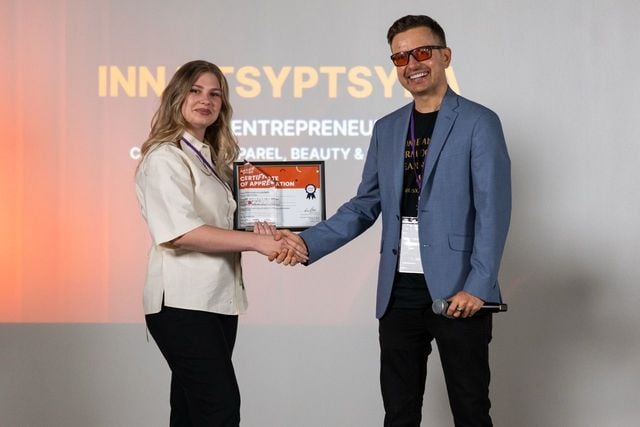
The evening award ceremony provided a counterpoint to the conference’s analytical focus. The nominations represented organizations that had navigated the implementation challenges dissected earlier. Projects ranged from industrial equipment redesigns (Abhishek Varadanam Mekala’s mixing gearbox housing integrating contamination protection) to global education platforms (Goldy Arora’s Classright) to financial infrastructure (Kaleshwar Aryasomayajula’s retirement plan workflow modernization)—each demonstrating that the technology works when fundamentals are addressed.
The award evaluation process reflected the same rigor the conference sessions demanded. An international jury board, comprising practitioners from technology, business development and digital transformation backgrounds, reviewed entries across all categories. Jury members including Dmitry Masyuk, Simran Ratnani, Anton Malinovskiy and Farzon Nosiri among others, assessed projects based on measurable results and business impact—the criteria that separate successful deployments from failed ones. Projects that reached the nomination stage demonstrated an important pattern: success isn’t about the technology purchased but the organizational discipline applied alongside addressing the fundamentals: training investment, data governance, and clearer implementation processes.
A correction is underway. Organizations are moving away from hiring “AI specialists” toward upskilling existing workforces through structured data analytics and implementation training. The 2026 shift reflects a hard-learned lesson: AI capability can’t be purchased and installed like software—it requires data governance, training investment, and management discipline.
The Cases & Faces Conference & Award functioned as a microcosm of this shift. International practitioners from different industries and markets reached similar conclusions from different starting points. When agency leaders, enterprise consultants, and product developers independently identify training gaps, data readiness, and question quality as primary failure causes, the pattern becomes difficult to dismiss as sector-specific.
The technology works. The question is whether organizations will address the fundamentals—training, data, implementation process—that determine whether it works for them.