


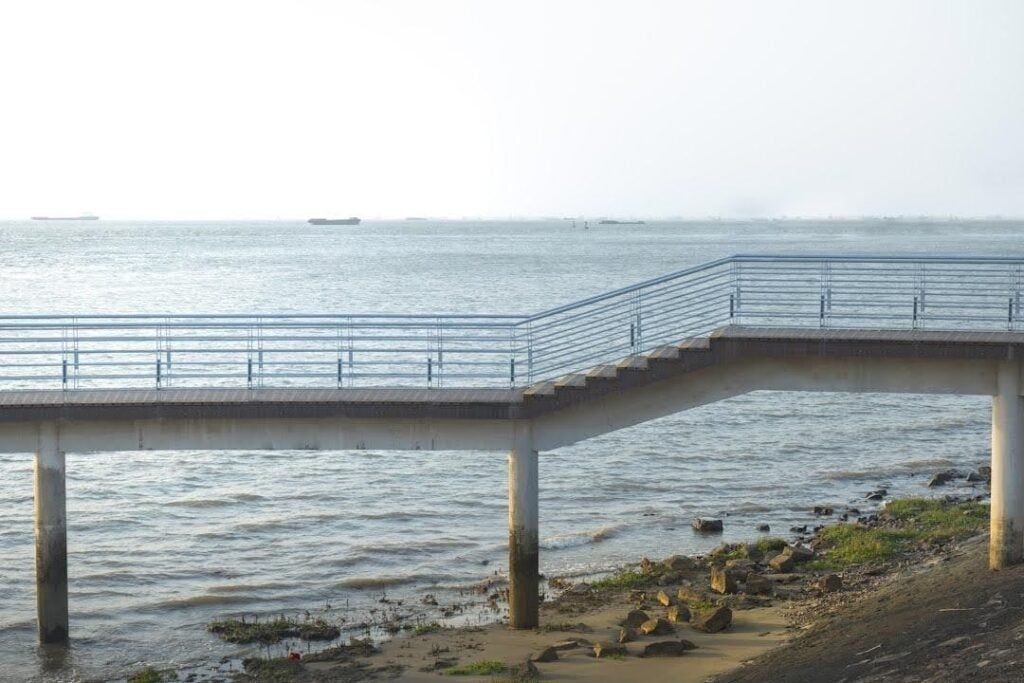
Facilities near saltwater environments face a corrosion problem that inland buildings never encounter. Salt-laden air reaches interior spaces through ventilation and occupant traffic.
That exposure changes which materials perform acceptably, and coastal facility managers converge on similar conclusions through experience.
How Does Salt Air Reach Interior Restrooms?
Salt aerosol enters buildings through ventilation systems, open doors, and on occupants themselves. Interior spaces in coastal buildings show measurably higher chloride exposure than equivalent inland facilities.
Beach-adjacent facilities including bathhouses and pier restrooms experience the most direct exposure. The effect extends further inland than most people assume.
What Does Chloride Exposure Do?
Chlorides accelerate corrosion of many metals and can attack even some stainless grades under sustained exposure. The mechanism is well characterized.
Coastal facilities specifying corrosion-resistant restroom partitions generally select stainless steel or solid plastic rather than powder-coated steel, since coated finishes fail at any breach and corrosion then progresses beneath the coating. The failure begins where the coating is compromised.
A scratch in a powder-coated surface becomes a corrosion initiation point. In coastal environments those points multiply quickly.
Why Does Grade Matter Within Stainless?
Not all stainless grades resist chloride equally, and some commonly used grades perform poorly under sustained salt exposure. Specifying stainless generically is insufficient.
Higher-alloy grades offer better chloride resistance at higher cost. Coastal specification should identify grade explicitly rather than relying on the general category.
How Does Solid Plastic Compare?
Solid plastic partitions do not corrode at all, which eliminates the primary failure mechanism in these environments. They also tolerate the moisture that frequently accompanies coastal facilities.
Hardware remains metal regardless of panel material, which means fastener and bracket selection still requires attention. The panel choice does not solve the whole problem.
What Should Coastal Specifications Address?
Specification for these environments generally covers several elements:
- Panel material resistant to chloride-driven corrosion
- Stainless grade specified explicitly rather than generically
- Fasteners and brackets in appropriately resistant materials
- Mounting that avoids trapping salt-laden moisture
- Cleaning protocols that remove rather than concentrate salt deposits
Hardware is where coastal specifications most often fall short. Panel material receives attention and fasteners do not.
How Does Cleaning Affect Corrosion?
Regular rinsing removes salt deposits before they concentrate, which meaningfully slows corrosion. Cleaning protocols in coastal facilities should account for this.
Cleaning that leaves salt residue in crevices can accelerate rather than slow deterioration. Technique matters as much as frequency.
What About Ventilation?
Ventilation systems drawing salt-laden air directly into restrooms increase exposure. Filtration and intake placement affect how much reaches interior surfaces.
This is a mechanical design consideration that partition specification cannot compensate for. Both should be addressed in coastal facilities.
How Should Service Life Be Estimated?
Manufacturer service life estimates generally assume standard commercial conditions rather than coastal exposure. Applying those estimates directly overstates expected performance.
Facilities with coastal history can estimate more accurately from their own replacement records. That experience is more reliable than general guidance.
What Does Inspection Reveal?
Regular inspection of fasteners, brackets, and panel edges catches corrosion while it remains addressable. Early-stage corrosion at a fastener is repairable and advanced corrosion is not.
Coastal facilities generally warrant more frequent inspection than inland equivalents. The deterioration timeline is compressed.
What Should Specifiers Confirm?
Specifiers should confirm material chloride resistance, explicit stainless grade where applicable, and hardware material alongside panel material. All three determine performance.
Requesting documentation of performance in comparable coastal installations is reasonable. Manufacturers serving these markets generally have it.
How Should Replacement Cycles Be Budgeted?
Coastal facilities should budget replacement cycles shorter than manufacturer estimates assume, since those estimates reflect standard commercial conditions. Building that into capital planning avoids surprise.
Facilities tracking their own replacement history can budget accurately rather than optimistically. That record is more valuable than any general guidance.
What About Fixtures Beyond Partitions?
Accessories, mirrors, and hardware throughout a coastal restroom face the same chloride exposure as partitions. Specifying corrosion-resistant partitions alongside standard accessories leaves the problem partially addressed.
A coordinated approach across all metal components produces consistent service life. Mixed specification produces staggered failures across the room.
What Does Seasonal Exposure Add?
Beach facilities frequently experience concentrated use during a season and sit closed during the remainder, which produces its own deterioration pattern. Closed facilities without ventilation can trap humidity.
Ventilating or dehumidifying during closed periods reduces that effect. Simply locking a coastal facility for months accelerates corrosion rather than pausing it.
How Should Rinsing Be Scheduled?
Regular freshwater rinsing of exposed hardware removes accumulated salt before it concentrates at fasteners and joints. The practice is simple and rarely scheduled.
Facilities that add this to routine maintenance generally report extended hardware life. It costs little beyond the time required.
How Should Coastal Projects Be Specified Differently?
Specifications for coastal work should state the environment explicitly rather than relying on a general commercial standard, since manufacturers offer different products and coverage for these conditions. Naming the exposure surfaces the appropriate options.
Suppliers experienced with coastal installations generally recommend different products than they would inland. That recommendation only happens if the condition is stated.
Coastal facilities converge on stainless steel and solid plastic because chloride exposure defeats coated finishes at any breach in the coating.
For coastal specifiers, the practical step is to specify grade explicitly and to address hardware material alongside panel material. Fasteners are where these specifications most often fail.