


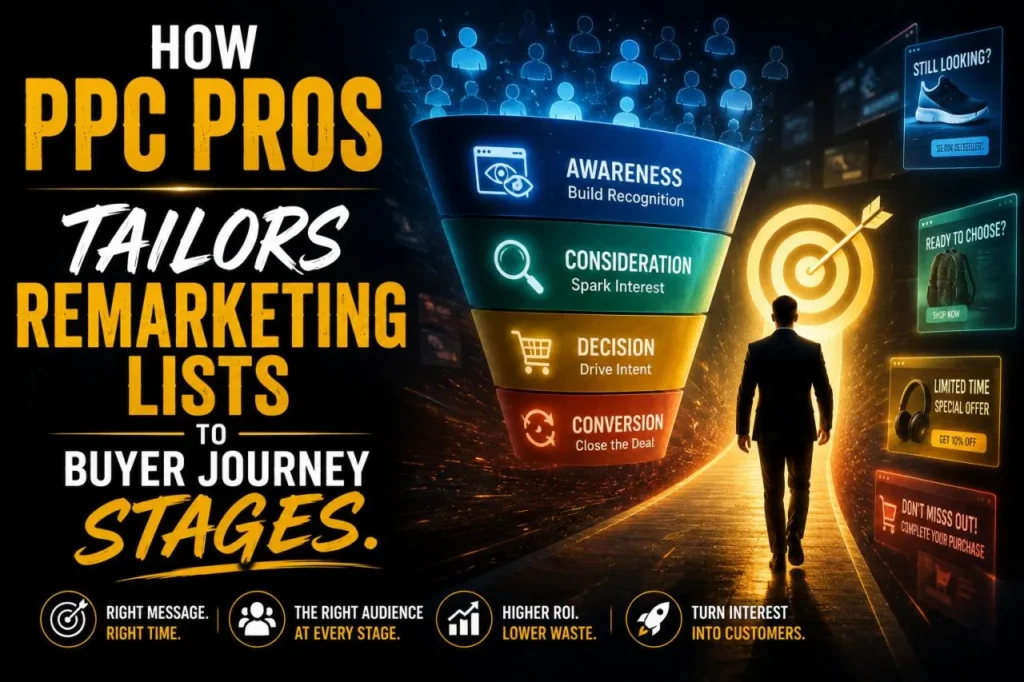
Remarketing is often described as a way to reconnect with people who have previously visited a website. While that definition is accurate, it overlooks an important distinction: previous visitors do not necessarily have the same level of interest, knowledge, or purchase intent.
Someone who reads an introductory article is in a different position from someone who visits a pricing page, returns several times, or begins filling out a contact form. Treating all of these visitors as a single audience can result in advertising that does not reflect what they were actually doing on the website.
One way advertisers can address these differences is by organizing remarketing audiences around stages of the buyer journey. Behavioral signals can provide context about what visitors have already explored and what information may be useful to them next.
What Is Remarketing?
Remarketing is an advertising strategy used to reconnect with people who have previously interacted with a business.
Depending on the advertising platform, available technology, privacy settings, and consent requirements, remarketing audiences may be based on actions such as:
-
Visiting a website
-
Viewing specific pages
-
Engaging with particular content
-
Starting a checkout or lead form
-
Interacting with an app
-
Completing a previous purchase or conversion
The purpose is to continue the interaction after an initial visit.
This matters because many purchasing decisions take place across multiple sessions. A prospective customer may discover a company while researching a problem, return later to compare services, review pricing at another point, and eventually decide whether to make contact.
Understanding the Buyer Journey
A simplified buyer journey is often divided into five stages:
Awareness → Consideration → Evaluation → Conversion → Retention
Real customer journeys are rarely this orderly. People can move between stages, conduct additional research, postpone decisions, or leave the process altogether.
Even so, these stages provide a useful framework for understanding differences between website visitors.
An awareness-stage visitor may still be trying to understand a problem. Someone at the evaluation stage may already know what they need and be comparing specific providers.
Those visitors are unlikely to need the same information.
Awareness: Supporting Early Research
Awareness-stage visitors are generally at the beginning of their research.
They may have:
-
Read an educational article
-
Visited a general service page
-
Viewed a guide or resource
-
Briefly explored the website
These actions do not necessarily indicate an immediate intention to purchase.
For early-stage audiences, remarketing can focus on continuing the research process rather than immediately pushing for a conversion. Relevant content might include guides, FAQs, tutorials, industry information, or explanations of a particular product or service.
The logical next step for someone who has read an introductory article may simply be learning more about the subject.
Consideration: Providing More Context
Consideration-stage visitors have typically moved beyond initial research and begun exploring possible solutions.
Their behavior might include visiting several service pages, returning to the website, reading case studies, or looking at detailed product information.
At this stage, prospective customers may be asking more specific questions. How does the service work? What separates one approach from another? What would the process involve?
Remarketing content can address those questions through case studies, process explanations, customer examples, and information about specific capabilities.
The focus shifts from introducing the subject to helping someone understand and evaluate the available options.
Evaluation: Responding to Stronger Intent
Certain website actions may indicate stronger commercial interest.
Visitors might look at:
-
Pricing pages
-
Contact information
-
Quote-request pages
-
Booking pages
-
Product pages
-
Consultation information
Repeat visits to these areas can provide additional context.
Someone at this stage may no longer need an introductory explanation. Instead, the remaining questions may involve pricing, process, availability, or what happens after making contact.
Remarketing messages for these audiences can therefore focus on practical information and clearer next steps.
Understanding Abandoned Conversions
Visitors who begin a conversion but do not finish can represent another distinct audience.
Examples include people who:
-
Add a product to a cart
-
Begin checkout
-
Start completing a lead form
-
Begin scheduling an appointment
-
Enter a quote-request process
These actions may indicate substantial interest, but they do not reveal why the visitor stopped.
Possible explanations include distraction, price concerns, complicated forms, technical problems, unexpected costs, or the need for additional research.
Remarketing may encourage some visitors to return, but advertising should not automatically be considered the solution. If many users abandon the same part of a conversion process, the website itself may need closer examination.
Using Behavioral Signals to Segment Audiences
Page-level behavior provides one practical way to think about remarketing audiences.
Blog and educational content, for example, may be associated with early research. Service or product pages can indicate more focused consideration, while pricing, contact, booking, or checkout pages may suggest stronger commercial intent.
Other signals can provide additional context.
Repeat visits may indicate continued research. Recency can show whether an interaction happened yesterday or several months ago. Product and service interests can also help distinguish between visitors researching different parts of a company’s offering.
Resources from paid advertising specialists such as PPC Pros can also be considered alongside broader industry guidance when researching how audience segmentation and remarketing fit into a paid search strategy.
The important point is that none of these signals should be treated as definitive evidence of what an individual person intends to do.
Instead, they provide clues that can be considered together.
Why Recency Matters
When someone visited can be almost as informative as what they viewed.
A person who visited a quote page yesterday may have a more immediate need than someone who casually browsed the website several months ago.
The appropriate remarketing window depends heavily on the buying cycle.
Someone searching for an emergency repair may have a need lasting only hours or days. A company researching enterprise software, commercial construction, expensive equipment, or professional services may spend months evaluating alternatives.
Audience duration should reflect the natural decision timeline rather than applying the same remarketing period to every campaign.
Segmenting by Product or Service Interest
Businesses offering several products or services can also consider what visitors actually researched.
For example, someone who spends most of a visit reading about paid search advertising may be more interested in additional information about PPC than unrelated content about website development.
The same principle applies to ecommerce.
A visitor who spends time browsing running shoes would generally expect subsequent advertising to have some relationship to that interest rather than an unrelated product category.
This type of segmentation can maintain continuity between the original website experience and later advertising.
Building Messages Around the Next Step
A useful question when developing remarketing campaigns is:
What would be a reasonable next step for this visitor?
For an awareness-stage visitor, that could be reading another educational resource.
For someone considering several solutions, it might be reviewing a case study or comparison.
For someone evaluating providers, it could be learning more about pricing or the consultation process.
For someone who abandoned a form or checkout, the next step may simply be returning to finish.
Thinking in terms of the next logical action can make remarketing more consistent with the customer’s research process.
Existing Customers Require Different Messaging
The buyer journey does not necessarily end with conversion.
Where platform capabilities and tracking allow, customers who have already completed the primary conversion can often be excluded from acquisition campaigns asking them to perform the same action again.
Depending on the business, existing customers may instead be relevant audiences for:
-
Repeat purchases
-
Renewals
-
Maintenance
-
Complementary services
-
Upgrades
-
Loyalty initiatives
Retention and cross-selling still require relevance. A previous purchase does not necessarily mean a customer should receive advertising for every other product or service a company offers.
Avoiding Excessive Remarketing
More exposure is not always better.
Repeatedly showing someone the same advertisement can lead to creative fatigue and may eventually make the advertising feel intrusive.
Advertisers can address this by considering different creative variations, audience duration, campaign frequency, and messaging for different stages of the journey.
Personalization should also remain proportionate. There is a difference between presenting information related to someone’s interests and creating advertising that makes a visitor uncomfortable about how closely their activity appears to have been observed.
Privacy and Remarketing
Remarketing operates within an evolving privacy and technology environment.
Businesses need to account for considerations such as:
-
Applicable privacy laws
-
Consent requirements
-
Advertising platform policies
-
Browser restrictions
-
Cookie limitations
-
Data-retention practices
-
Customer expectations
Some industries and audience characteristics can also be subject to additional restrictions on personalized advertising.
Audience strategies should therefore reflect current platform capabilities and applicable requirements rather than assuming every visitor can or should be tracked.
Measuring More Than Clicks
Click-through rate can provide useful information, but it does not necessarily show whether remarketing contributes to meaningful business outcomes.
Depending on the campaign, advertisers may also consider:
-
Conversions
-
Conversion rate
-
Cost per conversion
-
Qualified leads
-
Sales
-
Revenue
-
Return on ad spend
For lead-generation campaigns, downstream outcomes can be particularly useful. A form submission, for example, may be less meaningful if it rarely develops into a qualified opportunity or customer.
Attribution is another consideration. Someone may see a remarketing advertisement and later return through branded search or direct navigation. Looking exclusively at the final click can therefore provide an incomplete view of the customer’s path.
Keeping Audience Segmentation Practical
More segmentation does not automatically produce better remarketing.
Creating dozens of highly specific audiences can leave individual groups too small to use effectively while making campaigns more difficult to manage.
A simpler structure may provide a useful starting point:
General visitors: People who have not demonstrated strong commercial intent.
Engaged visitors: People who have explored important products, services, or educational content.
High-intent visitors: People who have visited pricing, contact, booking, checkout, or similar pages.
Converted customers: People who have already completed the primary conversion.
More detailed segments can be introduced when traffic levels and performance data justify them.
Testing Assumptions About Buyer Intent
Buyer journey stages provide a framework, not a perfect prediction of customer behavior.
Two people can visit the same page for entirely different reasons. Similarly, a behavior that appears to indicate strong intent may not always lead to a conversion.
Advertisers can test different headlines, creative approaches, calls to action, landing pages, offers, and audience windows to see how different groups actually respond.
Performance data can then help determine whether assumptions about audience intent reflect customer behavior.
A Buyer Journey Framework for Remarketing
A simplified remarketing structure can be summarized as:
Awareness → Education
Consideration → Information and comparison
Evaluation → Reassurance and practical details
High intent → Clear next step
Customer → Relevant retention messaging
The framework does not assume that every person follows these stages in sequence. Instead, it provides a way to think about how advertising can respond to different types of behavior.
The central principle is relevance. As a visitor’s relationship with a business changes, the information that is useful to that person can change as well.
Frequently Asked Questions
What is a remarketing audience?
A remarketing audience generally consists of people who have previously interacted with a business and meet specific criteria available through an advertising platform or connected technology.
Should all website visitors receive the same remarketing ads?
Not necessarily. Someone reading introductory content may have different information needs from someone reviewing pricing or beginning a conversion process.
How long should a remarketing audience last?
There is no universal duration. Audience windows depend on factors including the typical buying cycle, urgency of the customer’s need, platform capabilities, and campaign performance.
How can remarketing audiences be segmented?
Depending on available technology and platform capabilities, audiences may be organized using signals such as pages viewed, product or service interest, engagement, repeat visits, recency, conversion behavior, and customer status.
Does more segmentation always improve remarketing?
No. Extremely narrow audiences can become too small or unnecessarily difficult to manage. Segmentation is generally most useful when groups represent meaningful differences in behavior, interest, or likely intent.
Final Thoughts
Remarketing becomes more useful when previous visitors are viewed in context.
Someone discovering a subject for the first time does not necessarily need the same message as someone comparing providers, reviewing pricing, or returning to an unfinished form. Existing customers represent another situation entirely.
Organizing audiences around stages of the buyer journey provides one way to account for those differences without assuming that customer behavior is perfectly predictable.
The objective is not simply to advertise repeatedly to people who have visited a website. It is to consider what previous interactions suggest, determine what information might reasonably be useful next, and evaluate whether those assumptions lead to meaningful outcomes.
Approached this way, remarketing is less about repeatedly pursuing previous visitors and more about maintaining relevance as people move through their own research and decision-making process.