


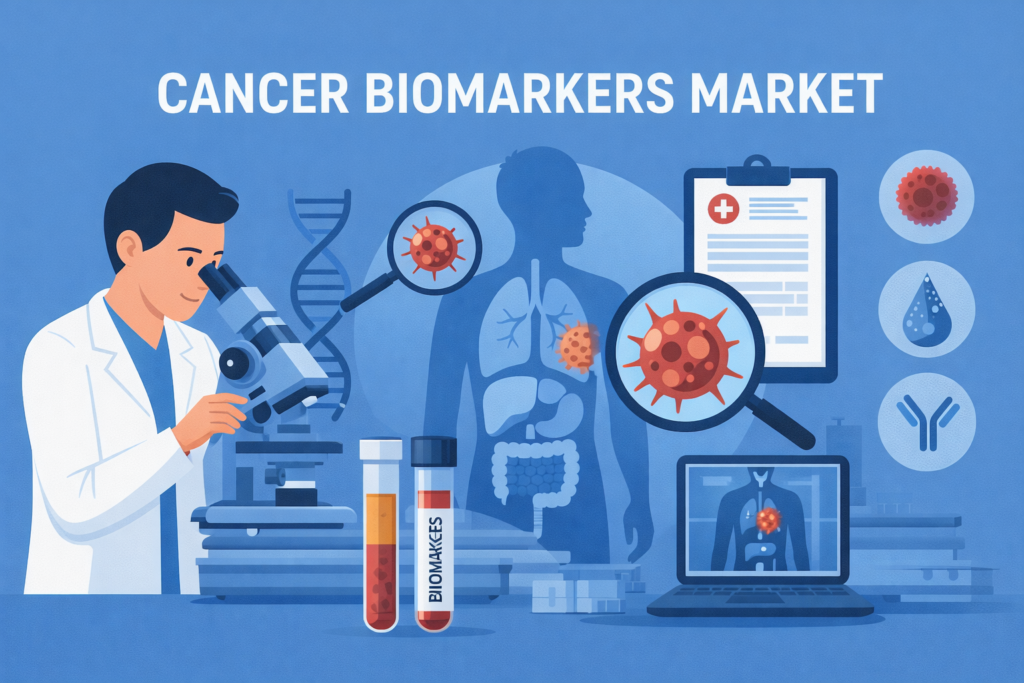
The global fight against cancer is undergoing a profound transformation, shifting from a one-size-fits-all approach to a highly targeted, personalized war. At the heart of this revolution lies the rapidly expanding field of cancer biomarkers—biological molecules found in blood, tissue, or other bodily fluids that signal the presence, type, or stage of cancer. This sector is not just a frontier of medical science; it has become a powerhouse of investment, innovation, and strategic corporate maneuvering, driving a market poised for explosive growth.
From Concept to Cornerstone: The Biomarker Boom
A cancer biomarker can be a gene, protein, or specific mutation that provides crucial intelligence. It can guide early detection (like PSA for prostate cancer), predict patient prognosis, indicate which therapy will be most effective (companion diagnostics), and monitor treatment response in real-time. The clinical and commercial impact is staggering: therapies paired with validated biomarkers show significantly higher success rates, while avoiding costly and ineffective treatments for patients who won’t benefit.
This utility has ignited a market frenzy. According to SNS Insider, The Cancer Biomarkers Market size was valued at USD 31.09 billion in 2024 and is expected to reach USD 72.64 billion by 2032, growing at a CAGR of 11.23% over the forecast period of 2025-2032. This growth is fueled by a perfect storm of factors: an aging global population, rising cancer incidence, skyrocketing demand for personalized medicine, and relentless technological advancement in genomics, proteomics, and artificial intelligence.
Investment and M&A: The Strategic Battlefield
The promise of this market has turned it into a hotbed for venture capital and strategic mergers and acquisitions. Investors are pouring billions into startups developing novel biomarker platforms, particularly those leveraging liquid biopsies—non-invasive blood tests that can detect cancer DNA. In 2024 alone, private funding rounds for companies like Freenome, Grail (now part of Illumina), and Guardant Health have consistently surpassed hundreds of millions of dollars.
The M&A landscape is even more telling, as industry giants move to consolidate power and fill technology gaps. Recent years have seen landmark deals:
- Thermo Fisher’s acquisition of Qiagen (2020) for $11.5 billion, a move squarely aimed at dominating the molecular diagnostics and biomarker space.
- Illumina’s contentious purchase of Grail (2021), a $7.1 billion bet on the future of multi-cancer early detection (MCED) blood tests.
- Roche’s continuous expansion through acquisitions like Foundation Medicine, solidifying its end-to-end platform from biomarker discovery to targeted therapy.
“Biomarkers are the new currency of oncology,” says Dr. Anya Sharma, a healthcare analyst at Global BioCapital. “Pharma companies need them to develop targeted drugs, diagnostic firms need them for tests, and payers are starting to demand them for cost-effective care. Controlling a pivotal biomarker platform is akin to controlling a toll bridge on the road to treatment.”
New Drug Development: The Inseparable Partnership
Perhaps the most critical dynamic is the symbiotic relationship between biomarkers and new drug development. The era of blockbuster chemotherapy is fading, replaced by targeted therapies and immunotherapies that are only viable with a companion diagnostic. Nearly 80% of oncology drugs in the pipeline are now being developed alongside a biomarker test.
Recent FDA approvals underscore this trend. Drugs like sotorasib (Lumakras) for non-small cell lung cancer are explicitly approved only for patients whose tumors harbor the specific KRAS G12C mutation, identified through a biomarker test. The success of checkpoint inhibitors (like Keytruda) is increasingly tied to biomarker signatures such as PD-L1 expression or tumor mutational burden (TMB).
“This biomarker-drug co-development model de-risks clinical trials and accelerates regulatory pathways,” notes Michael Chen, Head of Oncology R&D at a leading pharmaceutical company. “We’re no longer testing a drug on a broad, heterogeneous population. We identify the 10-20% of patients whose biomarker profile suggests they will respond dramatically, leading to better trial outcomes and faster access to life-saving medicine.”
Top Players and the Competitive Landscape
The market is a dynamic clash between established conglomerates and agile innovators.
The Dominant Forces:
- Roche Diagnostics & F. Hoffmann-La Roche: A behemoth with a closed-loop system from its Ventana tissue diagnostics to its Foundation Medicine liquid biopsy unit and its own portfolio of targeted therapies.
- Thermo Fisher Scientific: A powerhouse in analytical instruments, reagents, and now, with Qiagen, a leader in sample preparation and molecular diagnostics.
- Illumina: The genome sequencing titan, whose technology underpins most advanced biomarker discovery. Its spin-out/ re-acquisition of Grail positions it directly in the MCED market.
- Abbott Laboratories and Danaher (through subsidiaries like Beckman Coulter and Cepheid): Major players in routine and molecular clinical diagnostics with vast global distribution networks.
The Disruptive Challengers:
- Guardant Health: A pioneer in liquid biopsy for both therapy selection and early detection (Guardant Reveal, Shield).
- Exact Sciences: Known for Cologuard (colorectal cancer screening), now expanding into multi-cancer detection with its test pipeline.
- Personalized Immune Profiling Startups: Dozens of firms are using AI to analyze complex biomarker data (like genomic and proteomic profiles) to predict immunotherapy responses, attracting significant investment.
The Road Ahead: Challenges and Opportunities
Despite the optimism, hurdles remain. Reimbursement pathways for expensive novel biomarker tests are often slow and fragmented. Regulatory harmonization across different regions is a challenge. There is also an urgent need for greater standardization and validation of biomarkers to ensure consistency and reliability in clinical practice.
However, the trajectory is unmistakable. The integration of AI and machine learning to decipher complex biomarker patterns from massive datasets is the next frontier. Furthermore, the push towards early detection through multi-cancer screening blood tests could fundamentally shift oncology from late-stage treatment to early intervention, potentially saving millions of lives and billions in healthcare costs.
In conclusion, the cancer biomarkers market is more than a financial statistic; it is a barometer of progress in the war on cancer. The staggering projected growth to USD 72.64 billion reflects a collective bet on a future where cancer is not just treated, but precisely understood, intercepted early, and neutralized with personalized precision. As investment pours in, companies merge for scale, and drugs are born hand-in-hand with diagnostics, the biomarker revolution is redefining hope for patients and the economics of healthcare itself.