


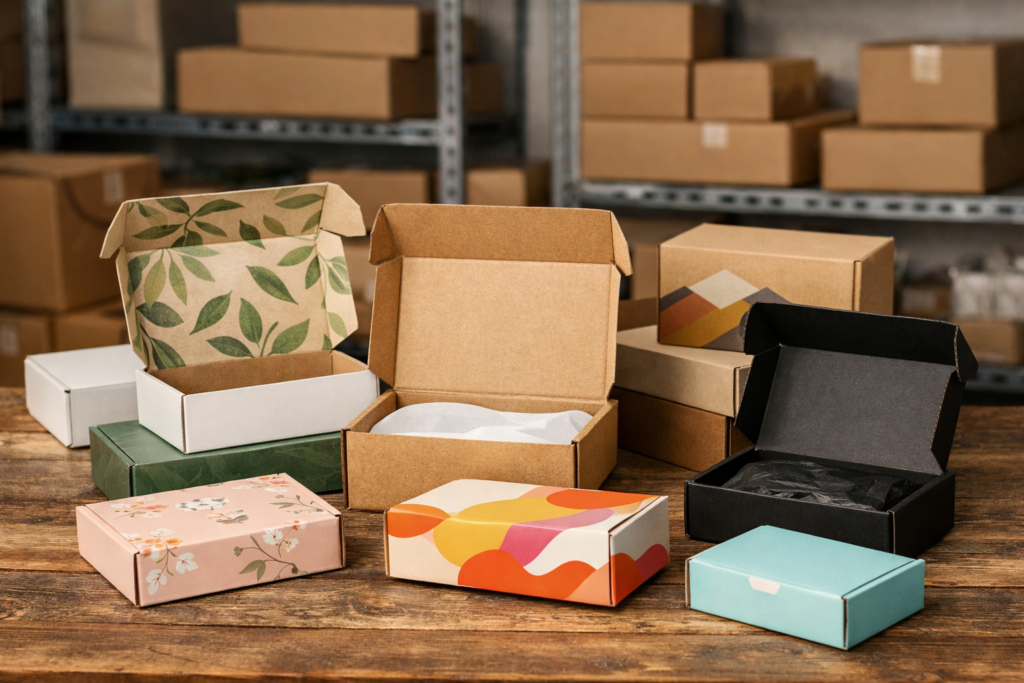
Key Takeaways
- Right-size shipping mailer boxes before anything else. A box that’s even 1–2 inches too big can raise shipping costs, increase filler use, and still leave products bouncing around in transit.
- Compare stock and custom shipping mailer boxes by reorder speed, not just unit price. For sellers shipping 50 to 1,000 orders a month, low-minimum corrugated mailer boxes often make more sense than tying up cash in bulk overbuys.
- Match the mailer to the product. Flat mailing boxes work well for prints, books, and literature, while stronger corrugated cardboard mailers are a better fit for cosmetics, small electronics, and graded collectibles.
- Test simple printed mailer boxes with a sample order first. A clean logo, one or two colored panels, and basic artwork can lift perceived value without forcing a large custom packaging commitment.
- Use a one- or two-size packaging plan to cut waste. Fewer shipping mailer boxes to stock means faster packing, easier forecasting, and less money sitting on shelves in slow-moving box sizes.
- Check whether poly mailers, padded mailers, or cardboard mailer boxes are actually the cheapest option for each SKU. The lowest packaging price upfront often loses money later through crushed corners, returns, and weaker reviews.
One bad delivery can wipe out the profit from ten good ones. That’s the math too many marketplace sellers learn the hard way—after a crushed corner, a broken item, and a review that mentions the packaging before it mentions the product. For brands shipping 50 to 1,000 orders a month, shipping mailer boxes have stopped being a back-office detail and started acting like a margin decision, a review decision, and a repeat-purchase decision all at once.
That shift matters more right now because postage keeps punishing dead space. A box that’s one or two inches too big doesn’t just need more filler; it can push dimensional weight higher and make a small order feel expensive fast. And for Etsy, Amazon, eBay, and Shopify sellers trying to look polished without sitting on 5,000 custom units, low-minimum printed packaging is finally getting a hard second look. In practice, the question isn’t whether custom is nice to have—it’s whether the old way of buying plain cardboard in bulk still makes sense when customer expectations, postal costs, and unboxing standards have all moved.
Why shipping mailer boxes matter more now for Amazon, Etsy, eBay, and Shopify sellers
Over coffee, the plain-English version is this: packaging has moved from back-office detail to front-line profit issue. For sellers shipping 50 to 1,000 orders a month, shipping mailer boxes affect reviews, postage, and perceived value all at once—and one bad box can undo a paid click, a repeat order, or a five-star moment.
How packaging complaints turn into bad reviews, returns, and wasted ad spend
Customers rarely write, “The corrugated failed at the corner.” They write, “Arrived damaged,” “looked cheap,” or “not as pictured.” Same problem. For handmade goods, cosmetics, small electronics, and literature orders, flimsy corrugated shipping mailer boxes protect the product and the brand story.
- Bad review: crushed corners or torn cardboard
- Return: product shifts in a box that’s too large
- Wasted ad spend: seller pays to win the order, then packaging kills trust
Why dimensional weight makes the wrong mailer box more expensive than it looks
Here’s what most people miss: a large mailer isn’t just extra packaging, it can trigger higher postal charges. An extra inch or two on each side—small on paper—can push mailing costs up fast, especially for bulk ecommerce orders moving through USPS and other carriers.
Where low-minimum custom packaging fits for brands shipping 50 to 1,000 orders a month
Low-minimum custom runs make sense in three cases: testing new artwork, upgrading from flat white stock boxes, or introducing colored packaging with a logo without buying 5,000 units. In practice, ecommerce shipping mailer boxes and durable mailer boxes for shipping work best when sellers standardize 2 or 3 sizes, order a sample first, and match box design to real order patterns—not wishful ones.
What buyers really mean when they search for shipping mailer boxes
About 30% of small sellers pick a box size based on what’s sitting in the supply closet, not on product fit—and that’s where damage, wasted filler, and dimensional weight start eating margin. In practice, buyers searching for shipping mailer boxes usually want three things at once: lower damage rates, cleaner presentation, and a custom option that doesn’t force a 1,000-unit commitment.
Stock vs custom shipping mailer boxes for short runs and repeat orders
For short runs, stock white, kraft, black, or colored boxes make sense because they’re fast, flat-packed, and easy to reorder. But once a seller is shipping the same SKU every week, ecommerce shipping mailer boxes with simple printed artwork or a logo often cost less than expected—especially if they replace labels, inserts, or decorated tissue.
- Stock: best for testing products, seasonal swings, and sample batches
- Custom: better for repeat orders, branded packaging, and review-driven categories
Corrugated mailer boxes, cardboard mailers, and flat mailing boxes: which one fits which product
Corrugated shipping mailer boxes work best for cosmetics, candles, graded cards, and small electronics because the structure protects corners during postal sorting. Cardboard mailers suit literature, paintings, picture prints, and poster flats. Flat mailing boxes are the smarter pick for documents, photos, and anything that shouldn’t bend in USPS or Priority mail.
When poly mailers or padded mailers beat a box—and when they definitely don’t
Soft goods first. Apparel, fabric, and low-risk bulk accessories usually ship cheaper in poly mailers or padded mailers. But fragile items? No. Durable mailer boxes for shipping beat bags every time for breakables, layered products, and anything where crushed packaging can trigger a bad review—or a return.
The practical case for low-minimum custom shipping mailer boxes
Overbuying boxes is one of the fastest ways to choke cash flow.
- Buy for the next 30 to 45 days, not the next six months. For sellers shipping 100 orders a month, smaller wholesale runs of shipping mailer boxes usually beat tying up cash in 1,000 units that may sit flat in a garage or stock room while product sizes, inserts, and rates keep changing.
- Perceived value shifts fast with simple design choices. Clean printed mailer boxes with a one-color logo, white or black interior, and restrained artwork often feel more premium than loud, overdesigned packaging—especially for Etsy and Shopify brands selling cosmetics, literature, apparel, or graded collectibles.
- Test before scaling. Smart operators order a sample, review digital proofs, and ship 10 to 20 live orders before a full run. That’s how sizing issues, crushed corners, weak tabs, and bad color choices show up early (before reviews do).
Why buying wholesale in smaller batches can protect cash flow better than bulk overbuying
Cash on the shelf can’t buy inventory. Smaller runs of corrugated shipping mailer boxes let sellers adjust packaging around seasonality, bundle changes, — postal rate pressure without getting trapped in old stock.
How printed mailer boxes with simple artwork, logo placement, and color choices change perceived value
In practice, ecommerce shipping mailer boxes don’t need full-color printing to look custom. A centered logo, one colored panel, and crisp cardboard stock can make a $24 product feel like a $34 one.
What most sellers miss about sample orders, proofs, and testing before a full run
A short test run with durable mailer boxes for shipping reveals the stuff sellers usually miss—dimensional weight creep, tape needs, insert fit, and whether the mailer actually survives USPS handling.
How to choose shipping mailer boxes that cut damage without inflating postal costs
An Etsy candle seller switched from one oversized mailer to two tighter sizes and saw crushed-corner complaints drop within a month. The bigger surprise was postage: dimensional charges fell, filler use dropped, and packing got faster. That’s the real math behind shipping mailer boxes.
For marketplace brands, the smart move is simple—fit the product first, then the brand. ecommerce shipping mailer boxes should protect the item, survive sortation, and avoid dead space that turns a small order into a large-rated shipment.
Matching box size to product size to reduce movement, filler, and crushed corners
Start with product dimensions, then add 0.5 to 1 inch for wrap or paper fill. Too much empty room invites corner failure; too little causes bulging. Good corrugated shipping mailer boxes ship flat, pack fast, and keep the product from rattling during mail handling.
- Cosmetics: snug fit with light paper padding
- Apparel: low-profile mailers or thin cardboard boxes
- Books and literature: tight edges, no overboxing
Picking corrugated strength for cosmetics, apparel, books, literature, small electronics, art prints, and graded collectibles
B-flute works for most small mailer and mailing needs; E-flute gives a cleaner printed surface for custom artwork, logo placement, and colored retail-style packaging. For books, small electronics, paintings, poster prints, or graded cards, durable mailer boxes for shipping need enough rigidity to resist flex—especially in USPS and postal networks.
White, black, pink, blue, kraft, and decorated mailers: when color helps the brand and when it backfires
White and black usually read clean. Pink or blue can work for gift, beauty, or sample programs—but only if the picture matches the product. Decorated or custom printed mailers look sharp, yet heavy design can cheapen premium goods if every panel shouts. In practice, simple branding wins.
Most people skip this part. They shouldn’t.
Are custom shipping mailer boxes actually practical at low minimums?
Yes—if the math works.
That’s where most sellers get stuck, because custom sounds expensive until they compare the full cost of generic boxes, loose inserts, extra tape, and damaged orders. The honest answer is that shipping mailer boxes become practical fast when the box size is tight, the print is simple, and the order is tied to a real sales window.
A simple cost test: generic boxes plus inserts vs custom printed mailers
Run one quick comparison for 100 orders. Generic cardboard boxes plus a printed insert, label, and added void fill often lands at $1.60 to $2.10 per shipment; low-minimum custom mailers can come in near $1.40 to $1.90 when the artwork stays clean—one or two colors, no complicated interior printing. For sellers shipping candles, skincare, or graded collectibles, corrugated shipping mailer boxes usually cut movement and reduce filler.
- Use generic if the product mix changes weekly
- Use custom if 1 SKU drives at least 60% of monthly orders
- Skip oversized boxes if dimensional weight is creeping up
What makes a low-minimum custom order workable for seasonal launches, subscription boxes, and product tests
Short runs work best for three cases: seasonal drops, monthly boxes, and product tests. In practice, ecommerce shipping mailer boxes make more sense when a seller can forecast 4 to 8 weeks of demand, not six months.
One- and two-size packaging plans that help growing sellers reorder faster and waste less
Simple wins. A one-size plan fits up to 70% of small orders; a two-size plan covers most brands without creating shelf clutter. That also makes durable mailer boxes for shipping easier to reorder, store flat, and keep consistent across Amazon, Etsy, eBay, and Shopify.
Frequently Asked Questions
What are shipping mailer boxes used for?
Shipping mailer boxes are used to protect products in transit while giving the package a cleaner, more branded look than a standard corrugated carton. They’re a strong fit for ecommerce orders like cosmetics, apparel, books, small electronics, literature, graded collectibles, and gift sets—especially when the unboxing experience matters.
Are shipping mailer boxes better than poly mailers?
For fragile or presentation-driven items, yes. Poly mailers are cheaper and lighter for soft goods, but mailer boxes hold shape, reduce crushing, and make custom printed packaging look far more intentional. If a product can bend, crack, or rattle, a cardboard mailer usually works better.
What size shipping mailer box should be used?
Pick a box that’s close to the product size, then allow roughly 0.5 to 2 inches for padding, inserts, or tissue. Small products need a snug mailer so they don’t slide around, while large but lightweight products need careful sizing to avoid dimensional weight charges.
For more great reading, visit our site and explore related topics.